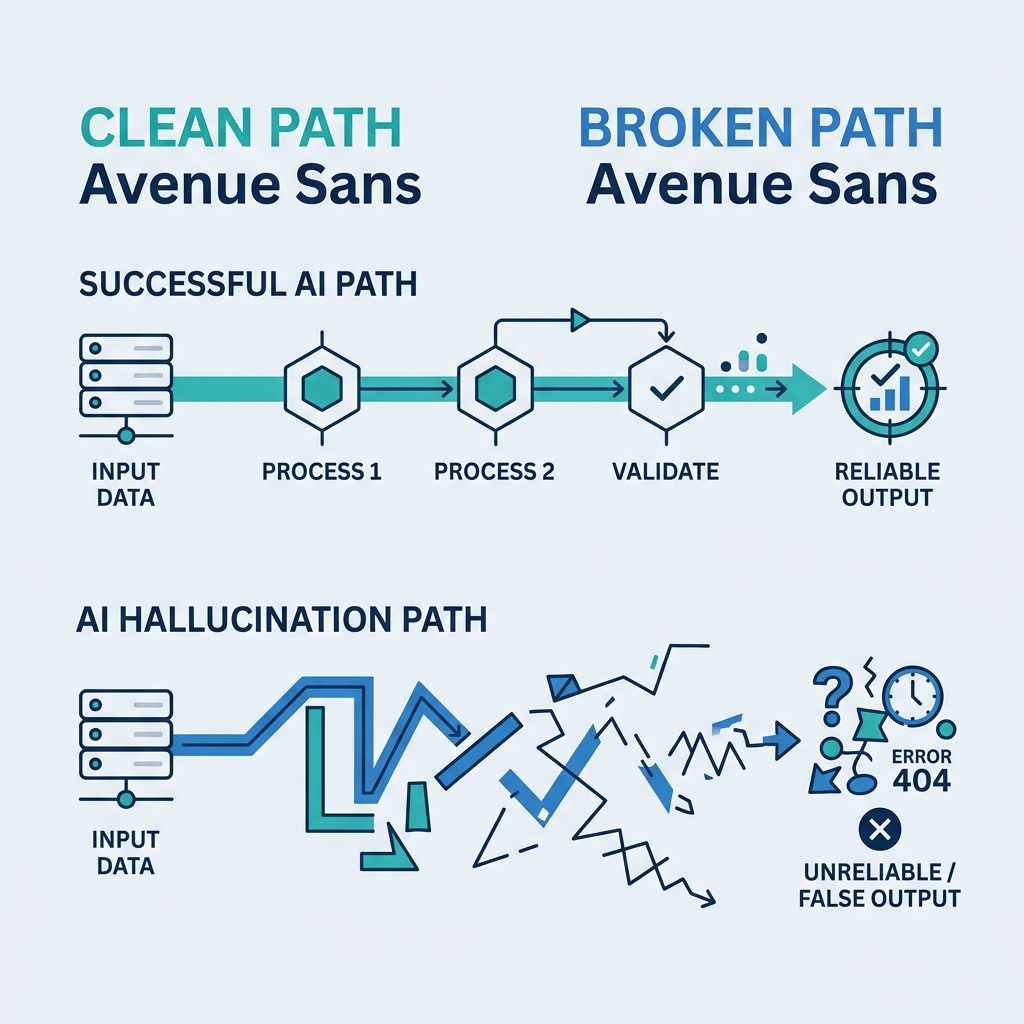
You ask an AI chatbot a simple question. It responds instantly. Perfect grammar. Confident tone. Clean explanation. Looks impressive.
Then you verify the answer… and realize the AI completely made it up. A fake API. An incorrect company policy. A hallucinated statistic. A wrong summary delivered with full confidence.
And if you are using AI inside a business, hallucinations are not just annoying — they are risky. Inaccuracy leads to legal issues, frustrated clients, and wasted operational hours.
The Real Problem: AI Is Not a Search Engine
Most people think AI works like Google. It doesn’t.
Models like ChatGPT are not databases storing verified facts. They are prediction systems trained to generate the most probable next word based on patterns from massive datasets.
That means the AI is optimized for:
- Sounding natural
- Generating fluent text
- Predicting linguistic patterns
It is not necessarily optimized for:
- Verifying truth
- Checking facts
- Understanding your specific business context
The “Frozen Brain” Problem
AI models also have another major limitation: their knowledge freezes after training.
If the model was trained months ago, it cannot know:
- Recent events
- Live product updates
- Real-time company APIs
- Internal customer data
More importantly, it has no built-in access to your internal systems, HR policies, or support logs. Which means your AI assistant is often answering enterprise questions without enterprise knowledge. That’s where problems begin.
The “Goldfish Memory” Problem
AI models also have limited working memory, commonly referred to as a Context Window. They can only process a limited amount of information at one time.
If you overload the model with:
- Large PDFs
- Massive spreadsheets
- Endless chat history logs
The AI becomes slower, more confused, and less accurate. More context does not always mean better answers. In fact, poorly formatted or bloated context is one of the biggest causes of hallucinations in enterprise AI systems.
How Businesses Actually Solve This
Smart companies don’t rely on the AI model's built-in memory alone. Instead, they use a technique called Retrieval-Augmented Generation (RAG).
1. User Query
"What is our refund policy for corporate clients?"
2. Semantic Retrieval
System searches trusted corporate knowledge base and retrieves policy docs.
"Corporate refund policy: Contracts terminated within 30 days receive 100% refund, minus a 5% admin fee."
3. Grounded Context + LLM
Verified docs are injected into prompt context. AI is instructed to answer strictly using this data.
4. Grounded Response
"Corporate clients receive a 100% refund minus 5% fee within 30 days." (Accurate & safe)
Before the AI attempts to generate an answer, the RAG system performs the following sequence:
- The system searches trusted company data for keywords or concepts related to the query.
- It retrieves the relevant fragments of verified documents.
- It injects that verified context directly into the prompt.
- The AI generates a response strictly grounded on the retrieved documents.
Instead of guessing, the AI answers using actual business information, which dramatically reduces hallucinations and keeps the AI accurate.
Bridging the Gap with SetuLytix
This is exactly why we built SetuLytix. We help businesses reduce AI hallucinations by giving AI systems secure, real-time access to actual company knowledge.
Instead of hoping the AI guesses correctly, SetuLytix ensures responses are grounded in:
- Enterprise documents & spreadsheets
- Internal database systems & operational APIs
- Trusted company knowledge bases
Because enterprise AI should answer based on your truth — not internet guesses.
Final Thoughts
AI is powerful. But without grounding, even the smartest chatbot can become confidently wrong. The future of enterprise AI is not just bigger models—it is better context, better retrieval, and grounded responses.
In business, accuracy matters more than sounding smart.
🚀 Try SetuLytix
Ground your AI chatbots with secure, real-time company knowledge to eliminate hallucinations.
Book a Demo