
📋 In this article you'll learn:
- What Prompt Engineering is & why prompts matter in AI.
- The core building blocks of high-performing prompts.
- Techniques like Chain of Thought and Self-Critique.
- Advanced architectures (ReAct, Tree of Thoughts) & industry use cases.
What is Prompt Engineering?
Prompt engineering is the process of designing and writing instructions that help AI models generate desired outputs. The prompt acts as the bridge between human intent and the model's parametric knowledge. In modern AI systems, prompt quality is the single most important factor determining success.
A prompt is simply an instruction provided to an AI model. Examples include:
• Summarize this document in 3 bullet points.
• Write Python code for login authentication.
• Act as a cybersecurity expert and review this API.
• Explain Kubernetes like I'm a beginner.
📊 How Prompt Engineering Works
The diagram below shows how user instructions guide AI behavior and influence the quality of responses.
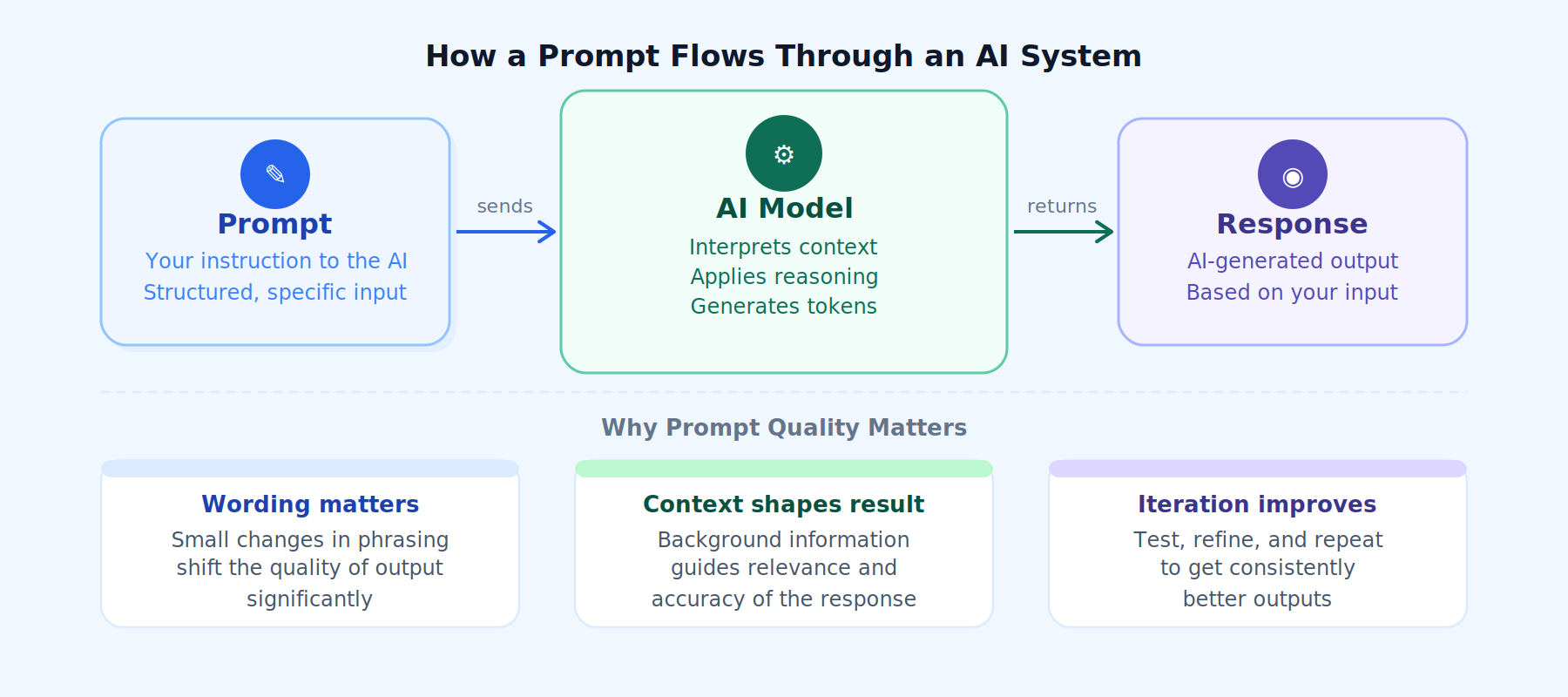
Why Prompt Engineering Matters
Modern large language models (LLMs) such as GPT-4, Claude 3.5, Gemini 1.5, and Llama 3 are extremely capable generalists, but they are highly sensitive to small details in their inputs. A minor change in phrasing can yield a completely different level of reasoning or output quality.
LLMs are sensitive to:
As enterprise organizations adopt AI, prompt engineering has evolved from a simple hobby into a critical engineering skill required in areas like AI Agent development, AI Security, and Workflow Automation.
Prompt = Instruction to the Model
Think of the AI model as a highly intelligent intern who follows instructions literally. If your instructions are vague, the results will be vague. Writing a prompt is exactly like specifying requirements for a task.
"Explain how vectors work."
"Explain vector databases to a web developer who knows JavaScript, using an analogy of a library."
Core Parts of a Prompt
A successful production-grade prompt is rarely a single sentence. It is a structured document built out of specific components:
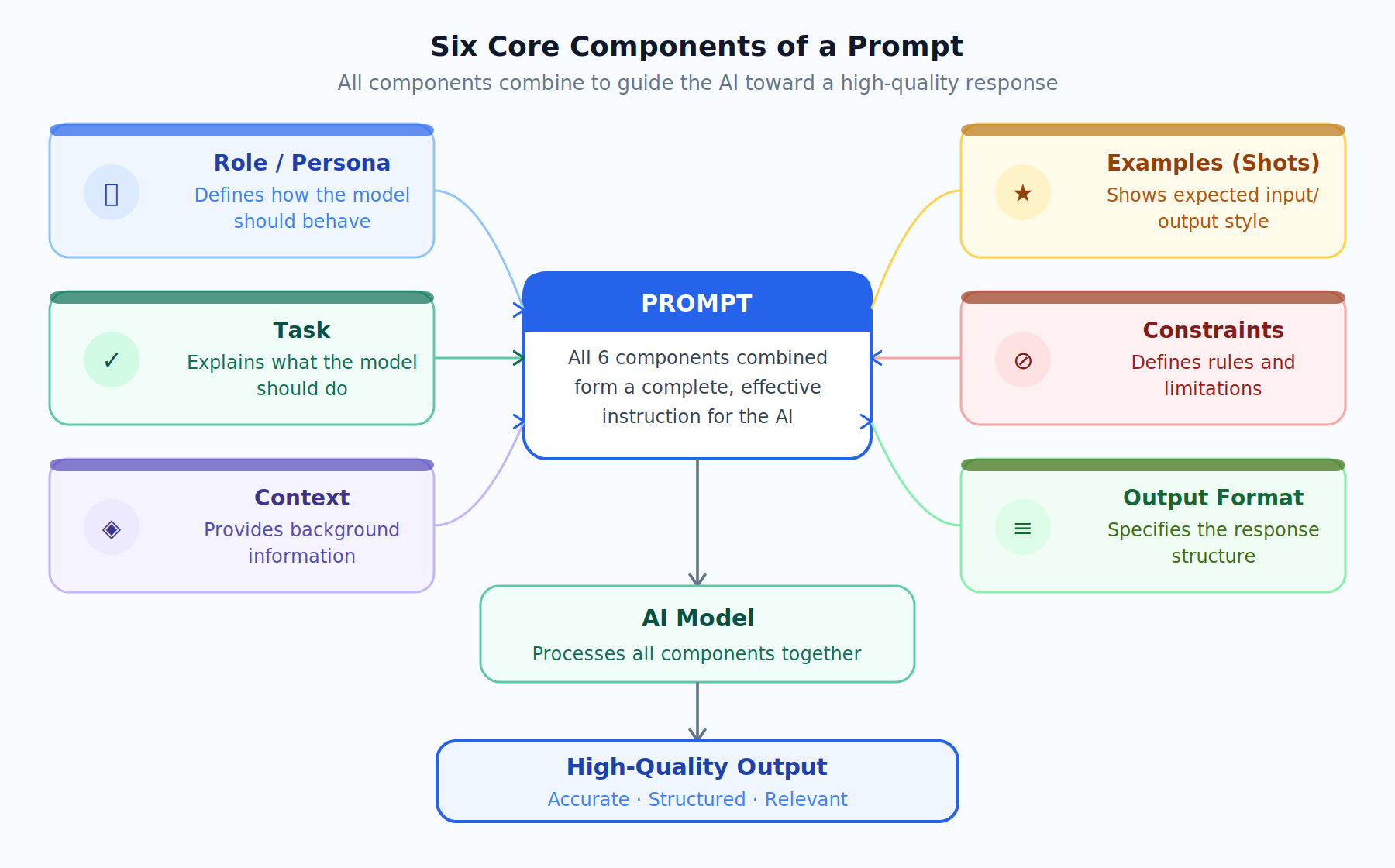
| Component | Purpose |
|---|---|
| Task Description | Explains exactly what the AI should do. |
| Role / Persona | Instructs the model how to behave, what tone to adopt, and what domain expertise to invoke. |
| Context | Provides background information, relevant business data, or database parameters. |
| Examples (Shots) | Demonstrates inputs and the exact style/structure of the expected outputs (In-Context Learning). |
| Constraints | Defines strict rules, limits (e.g. word count, no assumptions), and safety boundaries. |
| Output Format | Specifies whether the response should be JSON, Markdown, a code snippet, or bullet points. |
Role, Context & Examples
Role Prompting
Giving the AI a role directs it to prioritize a specific subset of its training data. For example, asking a model to review a contract "as a senior corporate lawyer" yields highly precise legal findings compared to a generic "review this text" prompt.
Act as a Cybersecurity Expert and review the following Node.js Express API endpoint for potential OWASP Top 10 vulnerabilities. Identify code flaws and provide corrected code blocks.
Context Matters
Context anchors the model and prevents it from making generic assumptions. If you want the AI to write marketing copy, tell it who the customer is, what the product values are, and what tone of voice your brand represents.
We are launching a premium B2B AI automation platform called SetuLytix. The target audience consists of Chief Technology Officers and Operations Directors who want to automate operations.
Write a LinkedIn announcement explaining our launch in a professional, metrics-driven tone.
Few-Shot Prompting
Few-shot prompting is the practice of providing the model with input-output examples to establish formatting patterns and execution style.
Classify the customer sentiment as Positive, Neutral, or Negative.

Input: "The setup was extremely easy and the support team answered in 5 minutes."
Sentiment: Positive

Input: "It works okay, but the loading speeds on the dashboard are slow."
Sentiment: Neutral

Input: "I have been locked out of my account for three days and nobody has replied."
Sentiment: Negative

Input: "I just registered today, testing it out."
Sentiment:
Chain of Thought (CoT)
Chain of Thought prompting instructs the model to lay out its intermediate reasoning steps before providing the final answer. This simple technique dramatically improves accuracy in mathematical reasoning, coding, and logical planning.
"A cafeteria has 23 apples. If they use 20 to make lunch and buy 6 more, how many apples do they have left?"
"The cafeteria has 27 apples left." (Incorrect)
"A cafeteria has 23 apples. If they use 20 to make lunch and buy 6 more, how many apples do they have left? Let's think step-by-step."
- Start with 23 apples.
- Use 20 for lunch: 23 - 20 = 3 apples left.
- Buy 6 more: 3 + 6 = 9 apples.
"The cafeteria has 9 apples left." (Correct)
Review this database schema, analyze potential query performance bottlenecks, and then generate the optimized SQL indexing strategy. Think step-by-step and write down your reasoning for each index before generating the query.
By writing out reasoning steps, the model is less likely to reach a hasty, incorrect conclusion because it uses token allocation to calculate intermediate logic.
Self-Critique Prompting
Self-critique prompting asks the model to evaluate its own initial outputs against a set of criteria and refine them. This creates a multi-step loop within a single session, significantly reducing code errors and hallucinations.
1. Generate a Python script to parse customer feedback and extract keywords.
2. Review the script you just generated. Check for edge cases, such as special characters and null inputs.
3. Identify potential optimizations.
4. Output the final, corrected script.
Advanced Prompting Techniques
Beyond basic prompting, modern AI engineers build system architectures that execute complex cognitive behaviors:
| Technique | How It Works |
|---|---|
| Self-Consistency | Generates multiple reasoning paths (chains of thought) and performs a majority vote to pick the most reliable final answer. |
| ReAct (Reason + Act) | Combines reasoning with action. The model thinks, decides to call an external API tool, receives the output, and reasons again. |
| Tree of Thoughts | Explores multiple parallel branches of thought, evaluates progress at each step, and backtracks if a path is deemed invalid. |
| Retrieval-Augmented (RAG) | Injects semantic search results from an external database directly into the prompt context to keep AI grounded on live data. |
Common Mistakes Beginners Make
| Mistake | Why it Fails | Correction |
|---|---|---|
| Vague Phrasing | The model has too much room to guess. | Use concrete terms and define boundaries. |
| Instruction Overload | Giving 15 instructions at once confuses attention. | Break tasks down into sequential steps. |
| No Output Formatting | Retrieving inconsistent string structures. | Ask for JSON with specified keys. |
| Blindly Trusting Outputs | Models will confidently hallucinate factual errors. | Inject source documents or use self-critique. |
Real-World Applications
Prompt engineering and structured context retrieval power the core interfaces of modern tools like GitHub Copilot, Cursor, and customer support intelligence. By standardizing prompts, developers ensure reliable operation at scale across hundreds of thousands of requests.
Prompt Engineering Template
Here is a reusable system prompt template that you can copy to start building structured instructions:
# ROLE
You are a Senior [Domain Specialist] with expertise in [Sub-domain]. Your tone is [Tone Description].

# TASK
Your objective is to [Goal Statement]. You will process the input data and generate the output.

# CONTEXT
We are building a [System Description]. The user is a [User Description] who needs to understand [Outcome].

# INSTRUCTIONS
1. Analyze the inputs carefully.
2. Check for [Edge Cases].
3. Detail your intermediate reasoning step-by-step.

# CONSTRAINTS
- Do NOT make assumptions. If data is missing, output 'DATA_MISSING'.
- Strictly use [Terminology].
- Limit the final output to [Length].

# OUTPUT FORMAT
Generate the response in the following JSON structure:
{
  "reasoning_steps": ["step1", "step2"],
  "final_answer": "text",
  "recommended_action": "text"
}
Final Takeaway
Prompt engineering is not about discovering "magical phrases." It is the science of reducing ambiguity, structure mapping, and guiding reasoning. The better you structure your communication, the better the AI will perform.
🚀 Try SetuLytix
Build and optimize custom prompts for customer support, document analysis, and enterprise workflows.
Book a Demo