Imagine asking a chatbot: "What is our company's leave policy?"
If that chatbot doesn't have access to your company documents, it answers purely from memory. Sometimes it guesses correctly. Sometimes it hallucinates confidently.
That is the biggest limitation of Large Language Models (LLMs). They are incredibly good at generating language, but they are not databases. They don’t automatically know your company policies, internal wikis, meeting notes, or private customer data.
Why Your AI Chatbot Sounds Smart... But Is Completely Wrong
LLMs have limits. They can't memorize every real-time update, their training data freezes in time, and your company data is completely private.
Furthermore, you can't just paste 5,000 PDFs into the chat window. The model will become expensive, slow, and confused due to context window limitations.
The Core Concept: Open-Book Access
Here is how RAG changes the equation: you can think of it as giving the AI open-book access instead of forcing it to take a test purely from memory.
| Without RAG | With RAG | |
|---|---|---|
| How it answers | Chatbot guesses from memory | Chatbot reads documents first |
| Data source | Static, public training knowledge | Dynamic, private enterprise data |
| Context | Uses the same context for everyone | Builds query-specific context dynamically |
| Result | Hallucinations increase | Answers are grounded and accurate |
From Feature Engineering to Context Engineering
In classical machine learning, developers spent all their time on feature engineering—structuring data so the model could understand it.
For LLMs, the game has changed to context engineering. Context is everything. The better the context you provide the AI, the better the answer it generates. RAG dynamically builds that context for each unique query.
Inside the RAG Data Pipeline
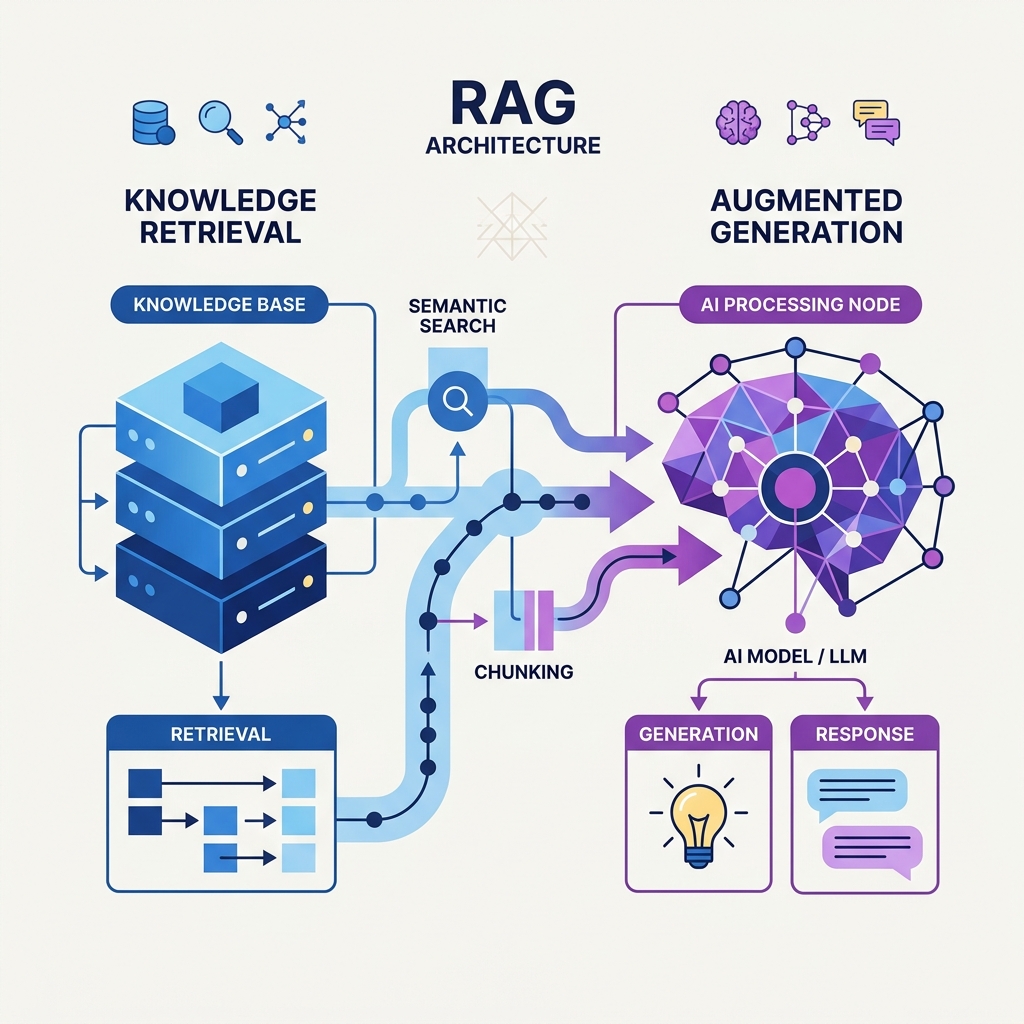
How does RAG actually construct query-specific context under the hood? Here is exactly how that pipeline works step-by-step:
The system ingests your raw data: PDFs, Word documents, wikis, contracts, or support tickets.
Remove junk characters, normalize formatting, and extract content. Garbage in equals garbage out.
Breaking large files into smaller chunks is vital. Bad chunking strategy destroys retrieval quality.
Embeddings convert text chunks into vectors—the GPS coordinates of meaning—capturing semantic similarity.
Embeddings are stored in vector databases (e.g. Pinecone, Qdrant, Milvus) optimized for similarity search.
When a user asks a question, that query is converted into an embedding using the exact same model.
The retriever searches the database for chunks whose vectors are mathematically closest (Nearest Neighbor Search).
Retrieved chunks + query are sent to the LLM. The model now answers using grounded company knowledge.
Reranking: The Secret to High-Precision Answers
A RAG system is only as good as its retriever. Sometimes, the initial retrieval isn't perfect—chunks might be slightly off-topic or too broad.
This is where Reranking comes in. A reranker is a secondary step that re-scores and re-orders the retrieved chunks before they hit the LLM. When token costs matter and precision is non-negotiable, reranking ensures only the absolute best context makes the cut.
RAG vs. Agents: The Modern Enterprise Stack
As you build out your architecture, you will encounter two dominant patterns:
- RAG: Its primary purpose is to retrieve knowledge and ground answers in trusted internal data.
- Agents: Their primary purpose is to take action (e.g., using APIs, searching the live web, or querying SQL databases).
The strongest enterprise systems combine both. For instance, RAG retrieves your internal HR policies, while an Agent checks a live calendar API, and the LLM generates the final response.
🚀 Ground Your AI with SetuLytix
Ground your AI agents and chatbots on verified business knowledge. Connect your databases, documents, and APIs securely.
Book a Demo