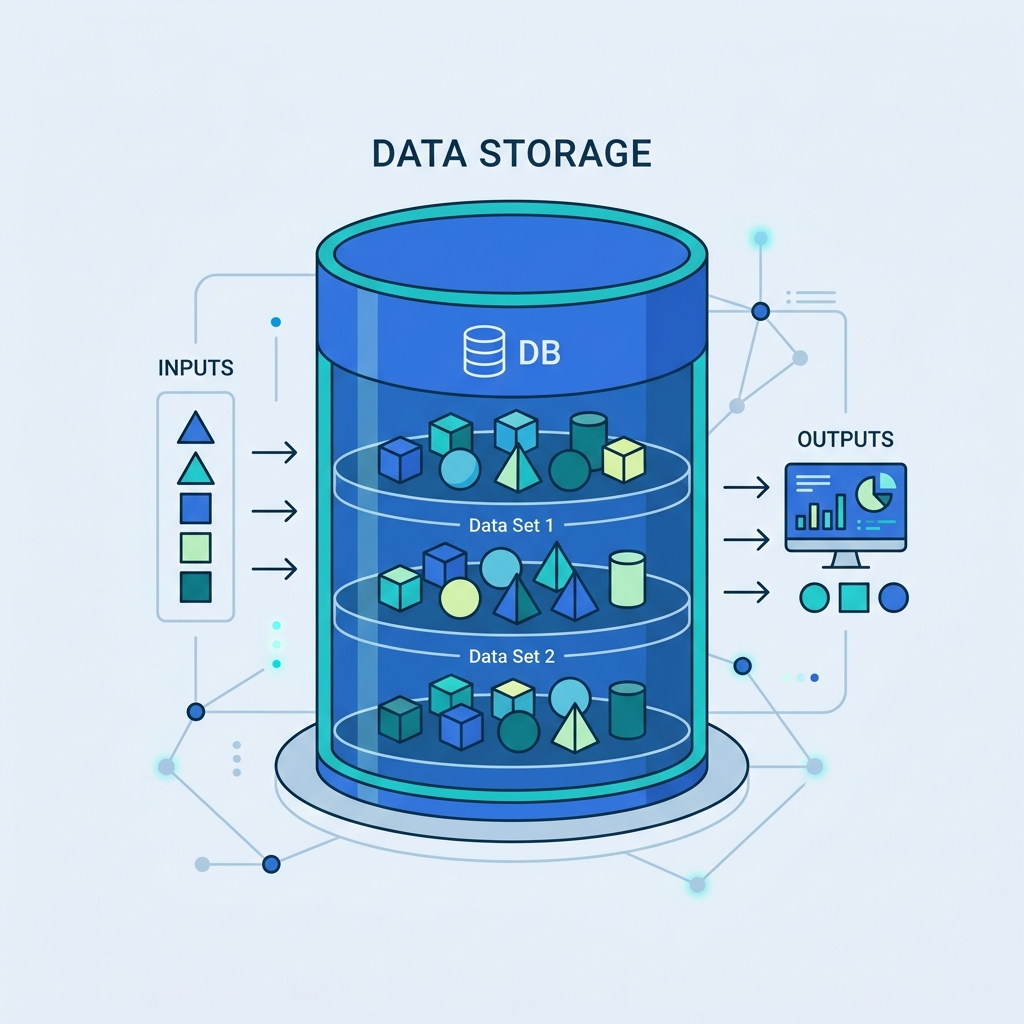
If you are a developer, you already know how to query a database. You write a SELECT statement, hit a Postgres or MongoDB instance, and look for an exact match. If user_id == 123, return the row.
But modern AI applications do not work on exact matches. They work on meaning, context, and similarity.
If an AI assistant needs to find a document about "terminating an employee," it shouldn't fail just because the database only contains the phrase "firing staff." It needs to understand that those two concepts are semantically identical.
Why Standard Databases Fail at AI
Standard databases excel at structured data and keyword matching. But AI data (like images, audio, and raw text) is completely unstructured.
As we covered in our previous blog, AI converts unstructured data into embeddings—long arrays of numbers (vectors) that represent the mathematical "meaning" of the data.
If you try to store a 1,536-dimensional vector in a standard SQL table and write a query to find the "closest" match, the database will have to calculate the distance between your query and every single row in the database (a K-Nearest Neighbor, or KNN, search).
If you have millions of rows, this process will take minutes. In a real-time AI application, that latency is unacceptable.
Vector Databases and ANN Algorithms
Vector databases solve latency issues by using Approximate Nearest Neighbor (ANN) algorithms (like HNSW). Instead of comparing your query to every single row, the database intelligently navigates a mathematical graph to find the closest vectors in milliseconds.
These databases index vectors much like a search engine indexes web pages. Rather than searching the entire index linearly, it clusters similar vectors together. When a query comes in, the search is confined to the most relevant clusters, ensuring query response times remain under 10-20 milliseconds even with billions of entries.
The Developer's Dilemma: Pinecone vs. pgvector
If you are building an AI application today, you generally have two paths for your vector infrastructure: a dedicated SaaS solution or an extension to your existing database.
Here is how the two most popular options stack up for developers:
| Feature | Pinecone | pgvector (PostgreSQL) |
|---|---|---|
| Architecture | Native, purpose-built vector database. | Open-source extension for PostgreSQL. |
| Hosting | Fully managed SaaS (Serverless). | Self-hosted or via managed SQL providers (AWS RDS, Supabase). |
| Setup Time | Minutes (API key and you are done). | Medium (Requires Postgres config and tuning). |
| Scaling | Scales automatically; handles billions of vectors easily. | Tied to your Postgres scaling limits; can get heavy at massive scale. |
| Best For | Fast-moving startups, massive scale, decoupled AI microservices. | Teams wanting to keep relational data and vector data in the exact same database. |
The Pragmatic Choice: If you want zero operational overhead and blazing speed, use Pinecone. If you already have a massive PostgreSQL database and want to run JOIN operations between your user's profile data and their vector embeddings, use pgvector.
Real-World Use Case: Image Analysis at the Edge
To understand why this infrastructure is so critical, let's look at a complex, real-world development scenario: Mobile-based Proof of Delivery.
Imagine you are building an application for a logistics company. A delivery driver snaps a photo of a package left at a door. You need an AI model, running efficiently on a mobile device, to identify if the correct product is actually in the image.

You can't rely on simple keyword tags. Instead, the system handles it dynamically:
- The system converts the driver's image into a vector embedding.
- It queries a vector database containing embeddings of your entire product catalog.
- The database instantly calculates the visual similarity between the delivered package and the expected product.
- If the vectors match closely, the delivery is verified. If they don't, the app flags an error.
A vector database makes this entire similarity comparison happen in milliseconds, allowing your backend to process thousands of deliveries concurrently without breaking a sweat.
🚀 Try SetuLytix
Connect your vector databases and run real-time automated workflows and semantic queries securely.
Book a Demo